Purchasing Ethereum on Binance.us Without Overpaying
Buying Ethereum on Binance.US is already cheaper than on most U.S. platforms. But “cheaper” doesn’t mean you can’t overpay. Between card fees, spreads, market orders, network fees, and a handful of easy-to-miss mistakes, it’s surprisingly common to lose 3% to 5% of a purchase before your ETH even settles. This guide, Purchasing Ethereum on Binance.us Without Overpaying, shows you exactly where those costs hide and how to avoid each one.
You don’t need to be a trader to do any of this. Most of the savings come from a few simple habits you set up once and then repeat.
Note: fees and rules change. Everything below reflects Binance.US’s published information as of September 2026. Always check the official fee page and help center before you trade.
Purchasing Ethereum on Binance.us Without Overpaying: Where Your Money Actually Goes
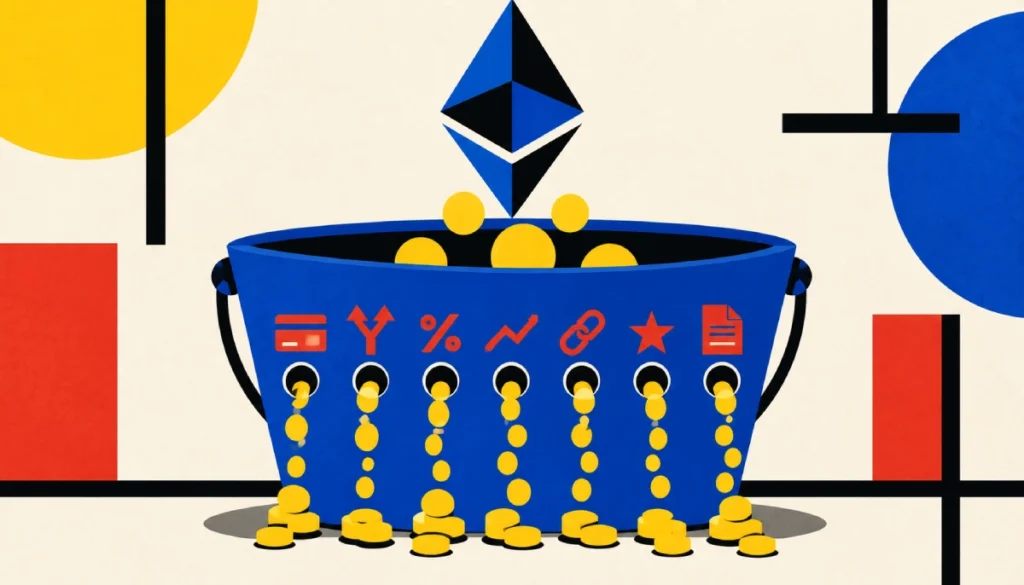
Every ETH purchase on Binance.US has up to seven separate cost points. Most people only notice one or two of them.
| Cost Point | When It Hits | Typical Size (at time of writing) | Can You Avoid It? |
|---|---|---|---|
| 1. Funding fee | When you deposit money | $0 by ACH; 3.99% by card | Yes, mostly |
| 2. Spread | When you use the simple Buy screen | Built into the quote | Yes, use Advanced trading |
| 3. Trading fee | When your order fills on Advanced trading | 0% maker; around 0.02% taker | Yes, with limit orders |
| 4. Slippage | When a market order fills at worse prices | Small on ETH/USD, larger in volatile moments | Yes, with limit orders |
| 5. Withdrawal fee | When you move ETH to your own wallet | Variable, based on network conditions | Partly, by batching and timing |
| 6. Staking commission | If you stake ETH on any platform | A share of your rewards | Partly, by comparing terms |
| 7. Tax drag | When you sell, trade, or earn rewards | Depends on your situation | Partly, with good planning |
The good news: the three biggest leaks, card fees, spreads, and taker fees, are also the easiest to fix.
Leak #1: Paying for Speed You Don’t Need
The single most expensive habit is paying by debit or credit card. Binance.US lists a 3.99% fee on card purchases, plus whatever your card issuer adds. Apple Pay and Google Pay use the card stored in your phone, so expect card-level pricing there too.
On a $1,000 ETH purchase, that’s about $40, which is more than every other cost on this list combined.
The Fix: Use ACH, and Plan Around the Hold
ACH bank transfers are free on Binance.US. The catch is a seven-day hold: you can trade with ACH funds right away, but you can’t withdraw USD or crypto bought with them until seven days have passed. A few other rules apply:
- Only personal checking accounts can be linked.
- Your bank account needs at least 130% of your deposit amount available, or the transfer can be rejected.
Here’s the trick most people miss: the hold only matters if you need to withdraw your ETH immediately. If you’re buying to hold, you’ll probably leave it on the platform for a few days anyway. Buy with ACH, wait out the week, then move your ETH to your wallet.
When a Wire Makes More Sense
Binance.US doesn’t charge for incoming wires, but your bank probably charges an outgoing wire fee. For a $300 purchase, a $25 bank wire fee is an 8% cost, which is terrible. For a $20,000 purchase, it’s about 0.1%, which is fine. Use wires for large deposits, especially if you want to move ETH off the platform sooner.
| Deposit Amount | Card (3.99%) | Wire (assuming a $25 bank fee) | ACH |
|---|---|---|---|
| $250 | About $10 | $25 (10%) | $0 |
| $1,000 | About $40 | $25 (2.5%) | $0 |
| $10,000 | About $399 | $25 (0.25%) | $0 |
ACH wins at every size. Wires only become reasonable at larger amounts.
Leak #2: The Spread on the Simple Buy Screen
The simple Buy screen shows no separate fee, which makes it feel free. It isn’t. Binance.US says the cost of Buy/Sell/Convert is built into the spread, meaning the quote you see is a bit higher than the true market price.
How to See the Spread for Yourself
Try this once and you’ll never forget it:
- Open the simple Buy screen and get a quote for $500 of ETH. Note how much ETH it offers.
- Without buying, open the Advanced trading screen and look at the ETH/USD order book. Note the lowest ask price.
- Divide $500 by that ask price. That’s roughly how much ETH you’d get with a market order.
- Compare the two amounts. The difference is what the convenience costs you.
The exact gap changes with market conditions, but on regular purchases it adds up fast.
The Fix: Switch to Advanced (Spot) Trading
The Advanced screen looks busier, but you only need three parts of it:
- The pair selector: choose ETH/USD if you deposited dollars.
- The order type: Limit or Market.
- The Buy button: after you’ve entered your price and amount.
That’s it. Ten minutes of practice with a small order and it becomes second nature.
Leak #3: Paying Taker Fees When You Could Pay Nothing
On the Advanced screen, Binance.US uses maker and taker fees:
- Taker orders fill immediately against an existing order. At the time of writing, they cost around 0.02% on most pairs.
- Maker orders rest on the order book until someone trades against them. They currently cost 0%.
0.02% is already cheap: $0.20 on $1,000. But if you buy regularly, zero is better, and it’s easy to get.
The Fix: The “Just Below Market” Limit Order
- Look at the current ETH/USD price.
- Place a limit buy slightly below it, for example 0.1% to 0.3% under the current price.
- Your order sits on the book as a maker order.
- ETH’s price moves constantly, so small dips often fill orders like this within minutes or hours.
- If it doesn’t fill and you’re in a hurry, cancel and adjust. There’s no fee for canceling.
You pay 0% in trading fees, and you often buy a little below the price you’d have paid with a market order.
A Note on the BNB Discount
Binance.US offers a 5% discount on Advanced trading fees if you pay them in BNB. With taker fees already around 0.02% and maker fees at 0%, that discount is tiny for most people. Don’t buy BNB just for this.
Leak #4: Slippage in Fast Markets
Slippage is the difference between the price you expected and the price you got. It happens when a market order has to climb through several price levels in the order book to fill completely.
On a busy pair like ETH/USD, slippage on typical retail-sized orders is usually small. It gets worse:
- During big news events, when prices swing quickly.
- On less-traded pairs with thinner order books.
- With large market orders that eat through several levels of the book.
The Fix
- Use limit orders. A limit order can’t fill at a worse price than the one you set.
- Split large purchases. Instead of one big market order, place several limit orders at slightly different prices.
- Avoid the most chaotic moments. If ETH just moved 8% in an hour, there’s rarely a reason to chase it with a market order.
- Choose the busiest pair. For USD deposits, ETH/USD is usually the most direct and liquid choice.
Leak #5: Withdrawal and Gas Fees
If you move ETH to your own wallet, you’ll pay a withdrawal fee. Binance.US uses a variable, network-based fee for crypto withdrawals, which reflects the cost of the Ethereum network (gas).
Why Gas Costs Change
Ethereum’s network fees rise and fall with demand. When lots of people are using the network at once, during a market frenzy or a popular token launch, fees go up. When things are quiet, they come down.
The Fix: Batch, Time, and Check the Network
- Withdraw less often. The fee is per withdrawal, not per dollar. One withdrawal of $2,000 usually costs the same as one withdrawal of $200, so ten small withdrawals cost ten times as much.
- Watch network conditions. Public gas trackers show current Ethereum fee levels. Quiet periods, often weekends and off-peak hours in U.S. and European time zones, tend to be cheaper, though there’s no guarantee.
- Check the withdrawal screen. Binance.US shows the fee before you confirm. If it looks high, you can wait.
- Select the right network. If Binance.US offers ETH withdrawals on more than one network, a lower-cost network only helps if your receiving wallet supports it. Sending on the wrong network can mean losing your funds entirely, which is the most expensive mistake of all.
- Send a small test first to any new address.
| Withdrawal Habit | Relative Cost Over a Year |
|---|---|
| Withdraw after every small weekly purchase | Highest (52 withdrawal fees) |
| Withdraw once a month | Moderate (12 fees) |
| Withdraw once a quarter or when balance reaches a set amount | Lowest (4 or fewer fees) |
Leak #6: Staking Commissions
Staking lets you earn rewards on ETH you hold. Binance.US offers ETH staking, and so do many other platforms. Every provider keeps a share of the rewards as a commission, and terms vary.
The Fix: Compare the Net Rate and the Rules
Before you stake, look at:
- The rate after the platform’s cut, not just the headline number.
- Unstaking terms: how long it takes to get your ETH back, and whether there’s a waiting period.
- Minimums: some staking products require a minimum amount.
- Tax treatment: in the U.S., staking rewards are generally treated as income when you receive them.
Staking isn’t a fee you pay upfront, but choosing a program with worse terms than you could get elsewhere is still a form of overpaying.
Leak #7: Tax Drag
Taxes aren’t a Binance.US fee, but they’re a real cost of owning ETH, and some of it is avoidable with good habits. In the U.S., crypto is generally treated as property.
- Buying ETH with dollars usually isn’t a taxable event by itself.
- Selling ETH, trading it for another coin, or spending it usually is.
- Staking rewards are generally taxed as income when received.
The Fix
- Avoid unnecessary crypto-to-crypto trades. Swapping ETH into another coin and back can create taxable events each time.
- Keep clean records. Download your Binance.US transaction history regularly. U.S. platforms now report customer sales to the IRS on Form 1099-DA, so your records need to line up.
- Know your holding periods. Assets held longer than a year may qualify for long-term capital gains rates, which are often lower.
- Talk to a tax professional if your situation is complex. This is general information, not tax advice.
Before and After: What Overpaying Looks Like
Let’s put it all together. Here’s the same $2,000 ETH purchase made two different ways.
The Expensive Way
| Step | Choice | Approximate Cost |
|---|---|---|
| Funding | Debit card | About $80 (3.99%) + possible issuer fees |
| Buying | Simple Buy screen | Spread built into the quote |
| Withdrawing | Four separate small withdrawals | Four network fees |
| Total | $80+ plus spread plus four withdrawal fees |
The Smart Way
| Step | Choice | Approximate Cost |
|---|---|---|
| Funding | ACH | $0 |
| Buying | Limit order just below market on ETH/USD | $0 in trading fees (maker) |
| Withdrawing | One withdrawal after the 7-day hold, during a quiet network period | One network fee |
| Total | One withdrawal fee |
Same ETH, same platform. The difference is roughly $80 plus the spread plus three extra withdrawal fees, all from a few different choices.
Your No-Overpay Checklist
Save this list and run through it every time you buy ETH on Binance.US.
Before you deposit:
- Is your state supported for USD deposits?
- Are you funding with ACH (or a wire, for large amounts)?
- Does your checking account hold at least 130% of the deposit amount?
Before you buy:
- Are you on the Advanced (Spot) screen, not the simple Buy screen?
- Are you using the ETH/USD pair (or the pair that matches what you deposited)?
- Is this a limit order placed slightly below the market price?
- If the purchase is large, have you split it into several limit orders?
Before you withdraw:
- Has the seven-day ACH hold ended?
- Are you withdrawing in one batch instead of several small ones?
- Have you checked the network fee shown on the withdrawal screen?
- Does the selected network match your receiving wallet?
- Have you sent a small test to any new address?
After you buy:
- Have you saved or exported your transaction records?
- If you’re staking, have you compared the net rate and unstaking terms?
Common Overpaying Mistakes (and Quick Fixes)
| Mistake | What It Costs You | Quick Fix |
|---|---|---|
| Paying by card out of impatience | About 4% of every purchase | Set up ACH once and use it every time |
| Using only the simple Buy screen | The spread on every purchase | Learn the three parts of the Advanced screen |
| Always using market orders | Taker fees and possible slippage | Default to limit orders |
| Withdrawing after every purchase | A network fee each time | Batch withdrawals monthly or quarterly |
| Wiring small amounts | Your bank’s wire fee as a big percentage | Use ACH for small deposits |
| Sending ETH on the wrong network | Possibly the entire amount | Double-check the network and test first |
| Frequent crypto-to-crypto swaps | Taxable events and extra trading costs | Only trade when you have a reason to |
| Buying BNB just for the fee discount | More than you’d save | Skip it unless you already hold BNB |
Advanced Tips for Regular ETH Buyers
Build a Simple Routine
If you buy ETH every week or month, make it a routine: schedule an ACH deposit for the same day each time, then place a limit order slightly below market when the funds arrive. It takes two minutes and keeps every purchase at close to zero cost.
Recurring Buys vs. Manual Limit Orders
Binance.US offers a recurring buy feature. It’s convenient and removes the temptation to time the market, but recurring buys typically follow simple Buy pricing, with the spread built in. If your priority is the lowest cost, manual limit orders are cheaper. If your priority is never having to think about it, recurring buys are a reasonable trade-off.
Set a Withdrawal Threshold
Instead of withdrawing on a schedule, withdraw when your ETH balance reaches a set level, say $1,000 or $2,500. That keeps the network fee small as a percentage of the amount you’re moving.
Keep a Small USD Buffer
A little extra cash in your Binance.US account lets you place limit orders the moment ETH dips, without waiting for a new deposit.
Frequently Asked Questions
What’s the cheapest way to buy ETH on Binance.US?
Deposit with ACH, which is free, then place a limit order slightly below the current price on the Advanced (Spot) screen using the ETH/USD pair. If the order rests on the book before filling, it’s a maker order, which currently costs 0%.
Is the simple Buy screen on Binance.US free?
No. There’s no separate fee line, but Binance.US builds its cost into the spread, so the quote is slightly above the true market price. For regular purchases, the Advanced screen is cheaper.
How much does it cost to buy ETH with a card on Binance.US?
Binance.US lists a 3.99% fee on debit and credit card purchases, plus any fees your card issuer charges. Credit card issuers may also treat crypto purchases as cash advances, which can add further fees and interest.
Why can’t I withdraw ETH I just bought?
If you funded the purchase with ACH, Binance.US holds those funds for seven days before you can withdraw them in USD or crypto. You can still trade during the hold. Wires and crypto deposits aren’t subject to this ACH hold.
How can I reduce ETH withdrawal fees?
Withdraw less often and in larger amounts, check the fee on the withdrawal screen before confirming, and consider waiting for quieter network periods. Only use a lower-cost network if your receiving wallet supports it.
Does the BNB discount make a big difference?
Not for most people. It’s a 5% discount on already-low Advanced trading fees, so the savings are usually very small. It’s not worth buying BNB just for the discount.
Are recurring buys a good way to save money?
They’re a good way to save time and stay consistent. For the lowest cost, placing your own limit orders is usually cheaper, since recurring buys typically follow simple Buy pricing.
Should I stake my ETH on Binance.US?
It depends on the terms. Compare the net reward rate after the platform’s commission, the unstaking timeline, and any minimums against other providers. Remember that staking rewards are generally taxable as income in the U.S.
Do I pay taxes when I buy ETH?
Buying ETH with dollars generally isn’t taxable by itself in the U.S. Selling, trading, or spending ETH usually is, and staking rewards are typically taxed as income. Keep good records and consult a tax professional if you’re unsure.
Final Thoughts
Overpaying for ETH rarely comes from one big mistake. It comes from small, repeated habits: a card payment here, a market order there, a few extra withdrawals every month. Fix those habits once and nearly every purchase afterward costs close to nothing beyond the network fee to move your coins.
We hope Purchasing Ethereum on Binance.us Without Overpaying gave you a clear playbook: fund with ACH, trade on the Advanced screen, use limit orders, batch your withdrawals, and keep good records. Put that routine in place and you’ll keep more of your money in ETH instead of fees. As always, only invest what you can afford to lose, since ETH’s price can move sharply in either direction.
Disclaimer: This article is for educational purposes only and does not constitute financial, investment, or tax advice. Cryptocurrency is volatile and involves risk. Fees, rules, and features may change, so always verify current details on Binance.US’s official website before trading.